Apologies for not blogging these past few weeks--I've been very busy with my new research project in Accra. I've been back in Ghana for about two weeks, but I'll definitely post about Cote d'Ivoire later this week, and then hopefully get back to more regular Ghana posting.
I don't currently have much time to write about recent Ghana news events, but the creation of a Constitutional Review Commission a couple weeks ago has generated a stir around Accra. Basically, the Commission will be re-evaluating the 1992 Constitution, a process that they promise will include the viewpoints of ordinary Ghanaians. Even the cab drivers have been giving me their two cents on Parliamentary oversight of the executive. More on this later.
Monday, January 25, 2010


Monday, January 4, 2010
Cote d'Ivoire
I am currently safe and sound in Accra, but will be travelling to Abidjan, Cote d'Ivoire early tomorrow morning. I may or may not have reliable Internet access, but I'll be sure to post updates and photos as soon as I can!
Also, the harmattan (desert winds from the Sahara) is blowing through Accra right now. Lots of haze in the sky and towards late afternoon the sun shines a pinkish red through the haze. Very dry and dusty.
Also, the harmattan (desert winds from the Sahara) is blowing through Accra right now. Lots of haze in the sky and towards late afternoon the sun shines a pinkish red through the haze. Very dry and dusty.
Friday, January 1, 2010
Maximum warp. Punch it.
Leaving for the airport in 5.5 hours. See you in West Africa.
[In case you don't know the origin of this post's title, this video will explain. Note to readers receiving my posts by e-mail: sometimes the videos don't go through via email.]
[In case you don't know the origin of this post's title, this video will explain. Note to readers receiving my posts by e-mail: sometimes the videos don't go through via email.]
Thursday, December 31, 2009
Whisper to their souls to go
This Saturday I'll be off again to West Africa, arriving in Accra on Sunday and then in Abidjan, Cote d'Ivoire by Tuesday. That's right, my research will be taking me to a new country, just west of Ghana, and I'm certainly excited by the prospect of seeing if the money I spent on the first two levels of Rosetta Stone French will actually pay off. (I'm also excited to see a new country.) I should be in Abidjan for 2-3 weeks, and then I'll be back to Ghana until mid-April working on another research project.
Of course, a new tour of Africa necessitates new gear--my more astute readers will note that this post comes right after the post-holidays sales...
First, Rosetta Stone, to enable me to communicate/ask where the bathroom is in French while in Cote d'Ivoire. RS is a clever program. It comes with speech recognition and all sorts of fancy pictures to aid one in learning a language. So clever, in fact, that I am convinced that the software is pre-programmed to identify which syllables in French will be most difficult for me to pronounce; ironically, many of these are true cognates, on which I shall elaborate below.
Nonetheless, RS is not entirely fool-proof, and I have found some gaps in their translations.
For example:
Les eleves d'ecole primaire aiment les sciences. = [look for the Asian kids]
Ce temps est le pire. = The weather is really bad. [look for the flying cows from Twister.]
Il joue du piano le mieux. = [look for the Asian kid]
Some exercises are less obvious, such as those that show you a picture and have you speak the caption. This exercise is hard in that the possibilities for the caption (as with New Yorker cartoons) are endless:
[Photo: Man eating alone at restaurant]
Me: "Uhhhh, l'homme dine a la restaurant ... ?"
[minor third chimes indicating incorrect answer]
Me: "Uhhhhh, l'homm--"
[minor third]
Me: "What the ..."
Answer that flashes on screen: "La femme est en retard." [The woman is late.]
Seriously? Wow.
Most of the time my microphone picks up what I say and it registers it correctly on the screen. There are however some glaring deficiencies--partly my own, but in my opinion partly the software's--with certain (mono-)syllables of the French language. Primarily,
bleu = blue
voiture = car
chaussure = shoe
d'Australie = from Australia
professeur = professor
For some reason, I often can't hit the right frequencies for these words. And this is where one gets ... Rosetta Stoned.
Speaking exercise, you will here three sample sentences. Please repeat the final sentence:
(1) La fille veut un chat. [The girl wants a cat.]
(2) Le garcon chante bien. [The boy sings well.]
(3, my turn) Le professeur d'Australie veut acheter une nouveau voiture bleu. Il ne porte pas des chaussures. (non sequitir? you get the point) The Australian professor wants to buy a new blue car. He does not wear shoes.
It feels something like this:
In actuality, RS has been great for teaching me French in the past six weeks, and I would recommend it. Especially with all those hidden gems.
I'm currently in packing mode right now. Much of today was spent figuring out how to re-treat my mosquito net with permethrin. I thought that would be a simple task. But, no, those instructions are remarkably difficult to find online. All these formulas you have to abide by ... and they don't really sell permethrin at high concentrations in individual-sized amounts. I mean, if it's that hard for me to figure out how to re-treat a net, then what's it like for the people in Africa who need it day in and day out? I ended up concocting a watered-down version with Sawyer's Permethrin solution for clothing, which has left my garage with hints of toxicity. Apparently it's also highly toxic to cats, and since none of my neighbors' cats have died on my lawn (yet), I think we'll be fine. Will it work in Africa? Perhaps, at least for a little while, right?
Je ne sais pas.
Wednesday, December 9, 2009
Give Me a Break
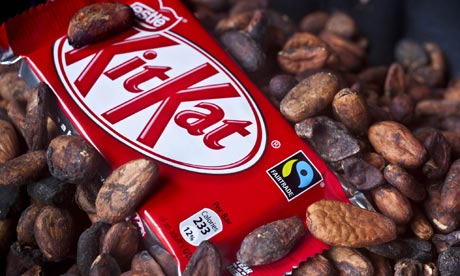
Apologies for the lack of posts over this past month--I spent much of November travelling up the East Coast visiting friends and family and basically just relaxing after five months in the field. It was good. However, I intend to get back to reporting on Ghana and fair trade now. Though, as I told someone earlier today, my blog should now be called "Out of West Florida", though that's not quite as exciting as "Out of West Africa." So it goes.
On Monday, approximately 23482301283.21 of my friends alerted me to the fact that Nestle was switching its line of British Kit Kats to Fairtrade. You know who you are. This barrage of e-mails--many of which arrived before I woke up that morning--has led me to believe that my friends now think of me whenever they see fair-trade or organically certified chocolate. Excellent. I, for one, cannot walk through a Whole Foods or a Wal-Mart (that covers the whole spectrum of grocery choice, right?) without nosing through the chocolate section, perusing the various organic, fairtrade, rainforest-friendly, we-love-the-insert-cause-here lines of chocolates. But I digress.
This is exciting news, nonetheless. In case you don't believe me, look at all these outlets covering the story:
The Guardian
Times of London
BBC News
Wall Street Journal
Nestle sources much of its chocolate from Cote d'Ivoire, a country to which I will be travelling in January. Cote d'Ivoire's cocoa system is set up quite differently from Ghana's, and the country's political situation is a bit more fractious--as a result, the cooperatives formed from this fairtrade switchover could have significant implications for democracy in Cote d'Ivoire. I guess we'll have to wait and see.
Update: Please see comments below for Mike Brady's perspective on Nestle's fairtrade Kit Kat announcement.
Thursday, November 5, 2009
Bring Me That Horizon
In just under 24 hours I will be rocketing away from Ghana, northwards to Amsterdam, westwards to the US, finally to home. Right now, I am trying to think how this research tour, my second in Ghana, differs from the first. At the outset of this tour, I felt more assured, more at ease with the daily inconveniences that come with this kind of work; consequently, I think I saw more.
Ironically, though, I saw more problems, more hardships here in Ghana, than I did the first time around. Part of that lies in the fact that this project has been far more rural than my previous one, but I think it more lies in the fact that I've been able to think more from a Ghanaian perspective. Though even that latter statement is erroneous: from an academic standpoint, is the Ghanaian perspective any different from how a rational, economically minded person would think?
I've worked very closely with bureaucrats of various ranks during this project. Why is it that some bureaucrats work so hard when there is no realistic chance of them getting promoted any time soon? Why does no one rebel against the culture of the "big man at the top" and the formalities that that entails? Where does all this government provision of public goods unravel?
Recently, a Ghana news agency reported on Cabinet ministers taking tro-tros around Accra to really relate to the transport problems that Ghanaians face. For one minister, this was the first time she had been in a tro-tro since 1992. I've probably been on more than 150 of these in the past five months. On camera, she pushed and shoved her way like everyone else into this vehicle; from inside, she lamented the cramped conditions, the lack of safety regulations. (I also wondered how they got the full news team in there, but I digress.) Another minister lasted about 17 minutes on a tro-tro before returning to his air-conditioned, carpeted office to hydrate and douse himself thoroughly with bottled water, gratefully rejoicing in the fact that he owned a private car to take him around. Seriously.
Also on the news, a large fire broke out in a tro-tro station at one of Ghana's main cities a couple weeks ago. This was a historical station and the tro-tro union's headquarters at that station was completely destroyed, wiping away decades of paper records, decades of history. The fire service was called immediately; they malingered, allowing a precious hour or so to pass before arriving. But their hoses stayed off: the electricity company hadn't turned off the power supply to the burning station, putting the fire fighters at risk of electrocution. (Is this actually a risk? I saw a similar thing on MythBusters, and I believe they debunked this.) But Ghanaians are creative, creative to the point of absurdity: people fought this fire by throwing sachet water at it. The station was a complete loss.
Ghanaians work hard. Our interviewer teams in the field work hard despite blazing heat, no electricity, gastrointestinal duress, malaria. Our bureaucratic contacts work hard. But why does the system not work? Why is there still corruption? Why is there still aloofness?
That's not to say that there aren't success stories, that there isn't the potential for more. People are creative. They search. They find. They get by. Once I could not roll down the window in a scorching hot taxi because the handle was broken. The passenger next to me unscrewed the handle of his window turner, and handed it to me, allowing me to slowly turn the screw, laboriously lowering the window.
A non-opening window is a simple problem, but honestly how do you fix it without any real tools? And imagine if it were a power window. But the solution was simple, and from what I could tell fairly common knowledge. It didn't even (financially) cost anything. It's a problem-solving attitude I've seen in so many common Ghanaians; despite failures in government, despite economic hardship, they get by. They get by cheerfully. It's a shame that somewhere along the line things fall apart. How do you pinpoint this problem and change behaviors? I don't know. And I don't know if the mindsets and incentives of the current ones at the top can be changed at this point.
But I think there is hope of that. Ghana has come a long way. We need to study these behaviors and incentives rigorously, and we just might have the tools, the resources, the intellectual creativity to do that now. In the meantime, life will still go on. Ghanaians will face problems; they will solve them. People will not be daunted by stuck windows and broken systems. Even if slowly and arduously--they will let in that fresh air.
Wednesday, October 28, 2009
Harvard Magazine features student projects in Africa
This month's issue of Harvard Magazine features students from the College working on a wide variety of projects in Africa, including a documentary on mental-health care and policy reform in Ghana and the development of vertical agriculture (VertiGrow) in Kibera, Nairobi. Today's evening news here in Ghana actually debated the progress of the mental-health bill in Parliament.
As a political-scientist-in-training, I found the VertiGrow article quite intriguing, namely in that it falls under the question of, "do interventions actually work?", a question that remains to be answered. Surely my fellow Easterly fans will enjoy this key quote:
Local ownership is certainly a key part of improving development outcomes. More broadly, this technology may have numerous implications for slums across the developing world, and it will be interesting to see how economic incentives and results are shaped by this product. One thing that just came to mind: if declining returns to agriculture result in increased urbanization, then wouldn't it be ironic if vertical agriculture helped people get out of the slums and into more productive settings?
Always something new out of Africa.
As a political-scientist-in-training, I found the VertiGrow article quite intriguing, namely in that it falls under the question of, "do interventions actually work?", a question that remains to be answered. Surely my fellow Easterly fans will enjoy this key quote:
Nowak was never sure what she would find each day when she arrived at the designated construction sites for the planters in Kibera. But she says her approach of letting the residents take the lead resulted in a product that merges the undergraduates’ ideas with local preferences and customs in a way that something designed wholly in a Harvard classroom never could.
Local ownership is certainly a key part of improving development outcomes. More broadly, this technology may have numerous implications for slums across the developing world, and it will be interesting to see how economic incentives and results are shaped by this product. One thing that just came to mind: if declining returns to agriculture result in increased urbanization, then wouldn't it be ironic if vertical agriculture helped people get out of the slums and into more productive settings?
Always something new out of Africa.
Subscribe to:
Posts (Atom)


